
Europe GDP 2025: Understanding the Regional Economic Landscape
European economic scale in a single frame, drawn from the IMF World Economic Outlook of October 2025 — and why scale alone is an incomplete basis for a European market strategy.
- Published
- August 14, 2026
- Reading time
- 5 min read
- Region
- Europe
- Industry
- Macroeconomics
- Author
- Momentum Miles Research
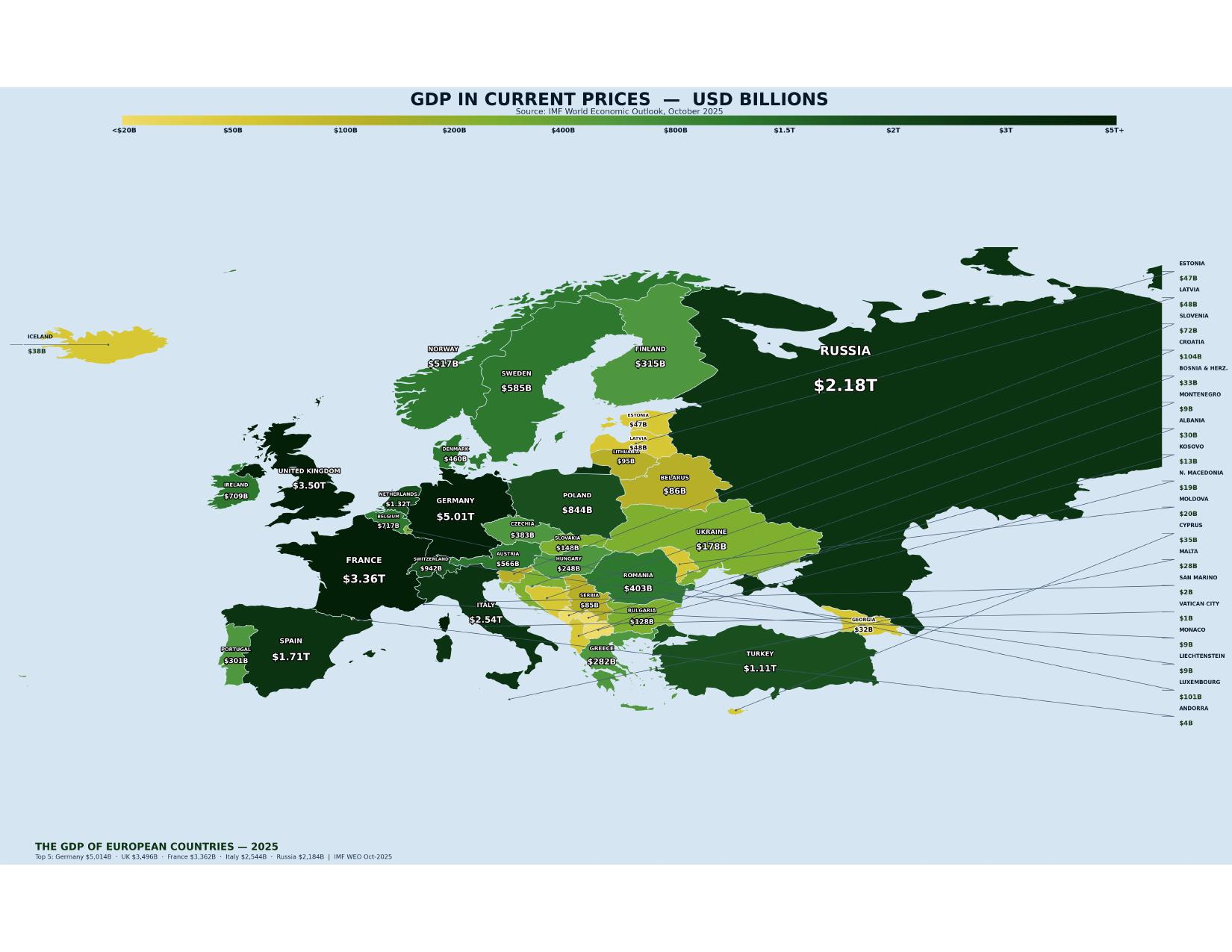
- The visual reports GDP in current prices, expressed in USD billions, sourced from the IMF World Economic Outlook, October 2025.
- The supplied visual identifies the five largest economies shown as Germany, the United Kingdom, France, Italy and Russia.
- Europe combines a small number of very large economies with a long tail of mid-sized and smaller markets, each with distinct regulation and route to market.
- Scale indicates where volume exists; it does not indicate where a specific proposition will succeed.
Europe is often treated as a single market and rarely behaves like one. The visual below reports GDP in current prices, expressed in USD billions, for European economies, sourced from the IMF World Economic Outlook, October 2025.
Concentration, and a long tail
The supplied visual identifies the five largest economies shown as Germany, the United Kingdom, France, Italy and Russia. Around them sits a long tail of mid-sized and smaller economies, each with its own regulatory framework, language, retail structure, distribution norms and buying behavior.
That combination is what makes Europe demanding. Scale is concentrated in a handful of markets, but access is fragmented across many. An organization that treats the region as one addressable market usually discovers the difference at the point of distribution.
What the measure means
- GDP in current prices
- The value of output measured at the prices and exchange rates prevailing at the time of measurement. It reflects scale, not purchasing power, growth quality or market accessibility.
- Why the distinction matters
- Two economies of similar nominal size can present entirely different commercial opportunities depending on category penetration, competitive intensity, regulation and route to market.
Using scale properly in market assessment
- Start with scale to frame which economies are worth examining at all.
- Layer in category-specific demand — the size of the market for the thing actually being sold.
- Assess regulatory and compliance conditions market by market, not region-wide.
- Map the route to market: partners, channels, retail structure and the cost of reaching a customer.
- Sequence entry by feasibility as well as opportunity.
This is the discipline behind Momentum Miles Global Intelligence: macroeconomic scale sets the frame, and local commercial reality decides the answer.
Sources
- IMF World Economic Outlook, October 2025, as attributed on the supplied visual.
- Momentum Miles Research.
Considering what this means for your organization?
Momentum Miles works with leaders evaluating markets, corridors and expansion decisions — turning intelligence into a defensible commercial position.
Related insights.
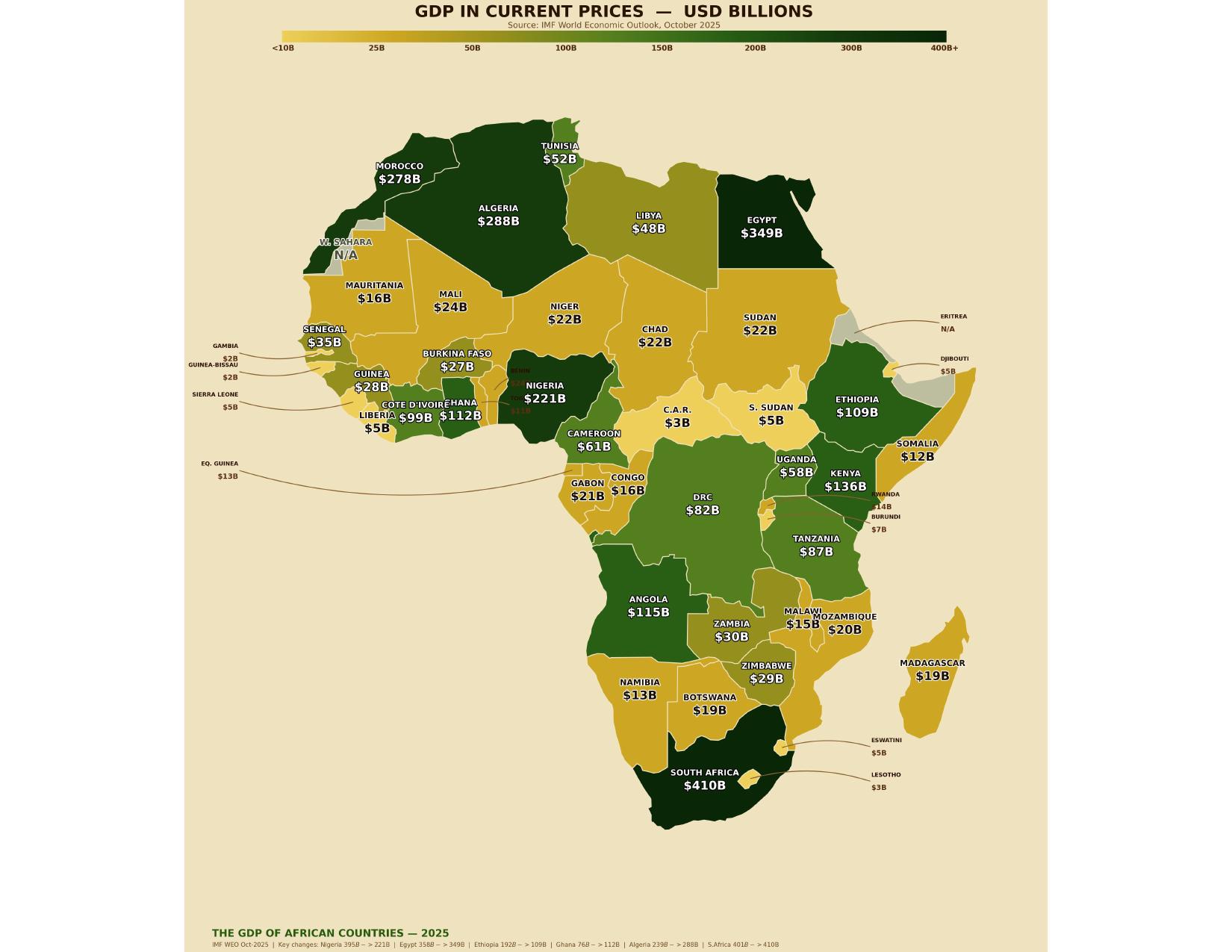
Africa GDP 2025: Mapping Economic Scale Across the Continent
Nominal GDP across African economies in current prices, and how macroeconomic scale should be used as one input into market prioritization.
August 12, 2026 · 5 min read

Spain & Italy Wine Market Intelligence: Industry Structure, Global Reach and African Opportunities
How Spain and Italy's wine economies differ, which companies lead on revenue, exports, production and prestige, and where their distribution reaches in Africa and Australia.
August 28, 2026 · 10 min read

The U.S. Market in 2026: Growth Engines, Uncertainty and Strategic Opportunity
Economic structure, the four drivers shaping 2026, and a sector-by-sector map of the U.S. market for organizations assessing entry or expansion.
September 1, 2026 · 8 min read