
Africa GDP 2025: Mapping Economic Scale Across the Continent
A single view of nominal economic scale across Africa, drawn from the IMF World Economic Outlook of October 2025 — and a note on how macroeconomic scale should, and should not, be used in market prioritization.
- Published
- August 12, 2026
- Reading time
- 5 min read
- Region
- Africa
- Industry
- Macroeconomics
- Author
- Momentum Miles Research
- The visual reports GDP in current prices, expressed in USD billions, sourced from the IMF World Economic Outlook, October 2025.
- Nominal measurement reflects prices and exchange rates at the time of measurement — it is a measure of scale, not of purchasing power or growth quality.
- Economic scale indicates the size of an addressable economy; it does not indicate demand for a specific product or category.
- Macroeconomic scale is one input into market prioritization, alongside industry structure, regulation, route to market and local commercial reality.
Economic scale is the first question most organizations ask about a continent, and the least useful one to answer alone. The visual below reports GDP in current prices, expressed in USD billions, for African economies, sourced from the IMF World Economic Outlook, October 2025.
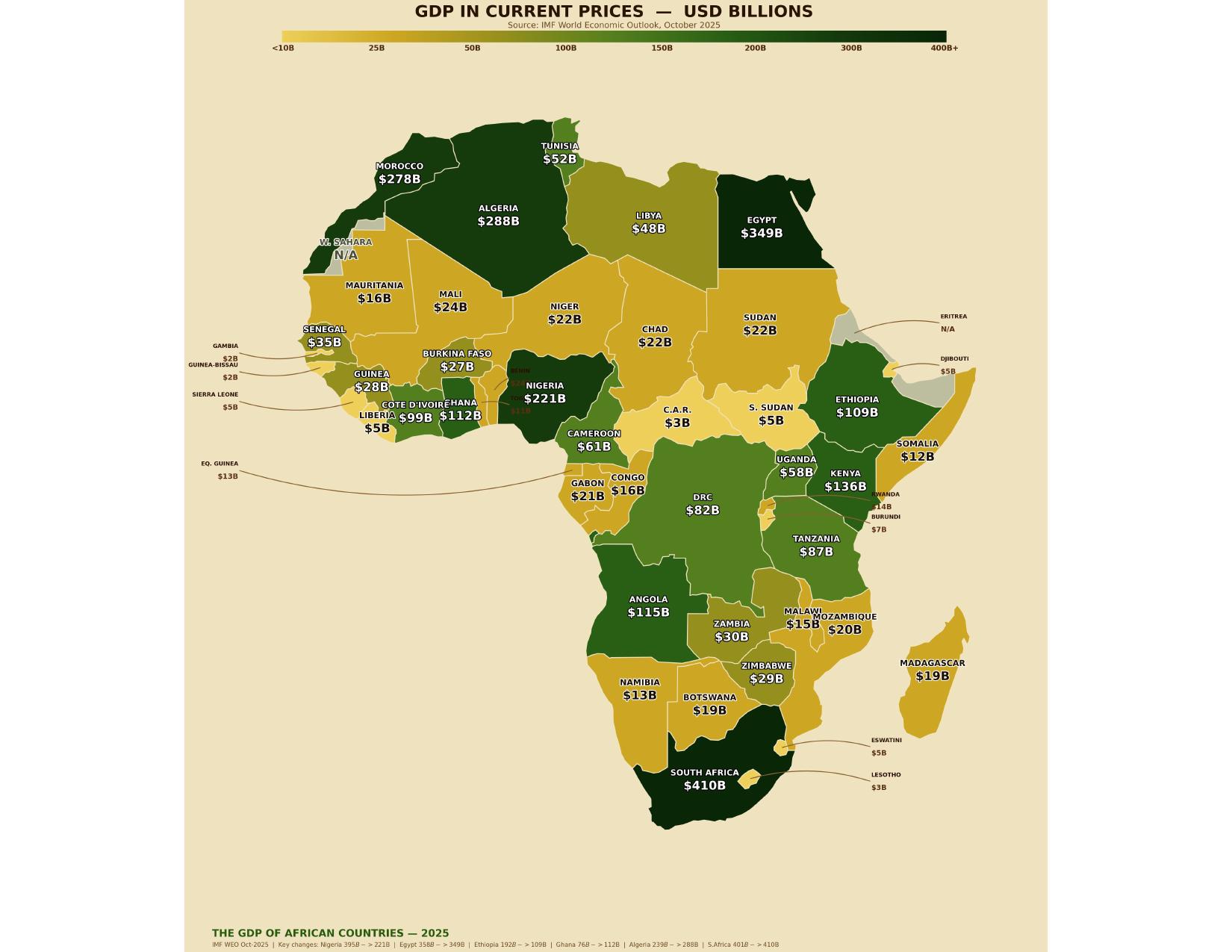
What the measure does and does not say
GDP in current prices measures the value of output at the prices and exchange rates prevailing at the time of measurement. It is a measure of scale. It is not a measure of purchasing power, of the quality or durability of growth, or of how easily value can be captured by a company entering the market.
- What scale indicates
- The size of the addressable economy — how much economic activity exists to be participated in, and therefore the theoretical ceiling on a market opportunity.
- What scale does not indicate
- Demand for a specific product or category, the structure of the industry serving it, the regulatory conditions attached to it, or the practical route to reaching a customer.
How we use macroeconomic scale
At Momentum Miles, macroeconomic data is one input into market prioritization — the starting frame, not the conclusion. It sits alongside industry structure, competitive intensity, regulatory conditions, channel and distribution reality, and the local commercial dynamics that determine whether a proposition can actually be sold. Our Global Intelligence work exists precisely because the difference between a market's size and a market's accessibility is where most expansion decisions are won or lost.
- Establish scale — understand the size of each economy under consideration.
- Narrow by relevance — identify where the specific category, sector or capability actually has demand.
- Test accessibility — examine regulation, channels, partners and local commercial conditions.
- Prioritize — sequence markets by the combination of opportunity and feasibility, not by size alone.
Read that way, a GDP map is a useful orientation device. Read as a ranking of opportunity, it is misleading.
Sources
- IMF World Economic Outlook, October 2025, as attributed on the supplied visual.
- Momentum Miles Research.
Considering what this means for your organization?
Momentum Miles works with leaders evaluating markets, corridors and expansion decisions — turning intelligence into a defensible commercial position.
Related insights.
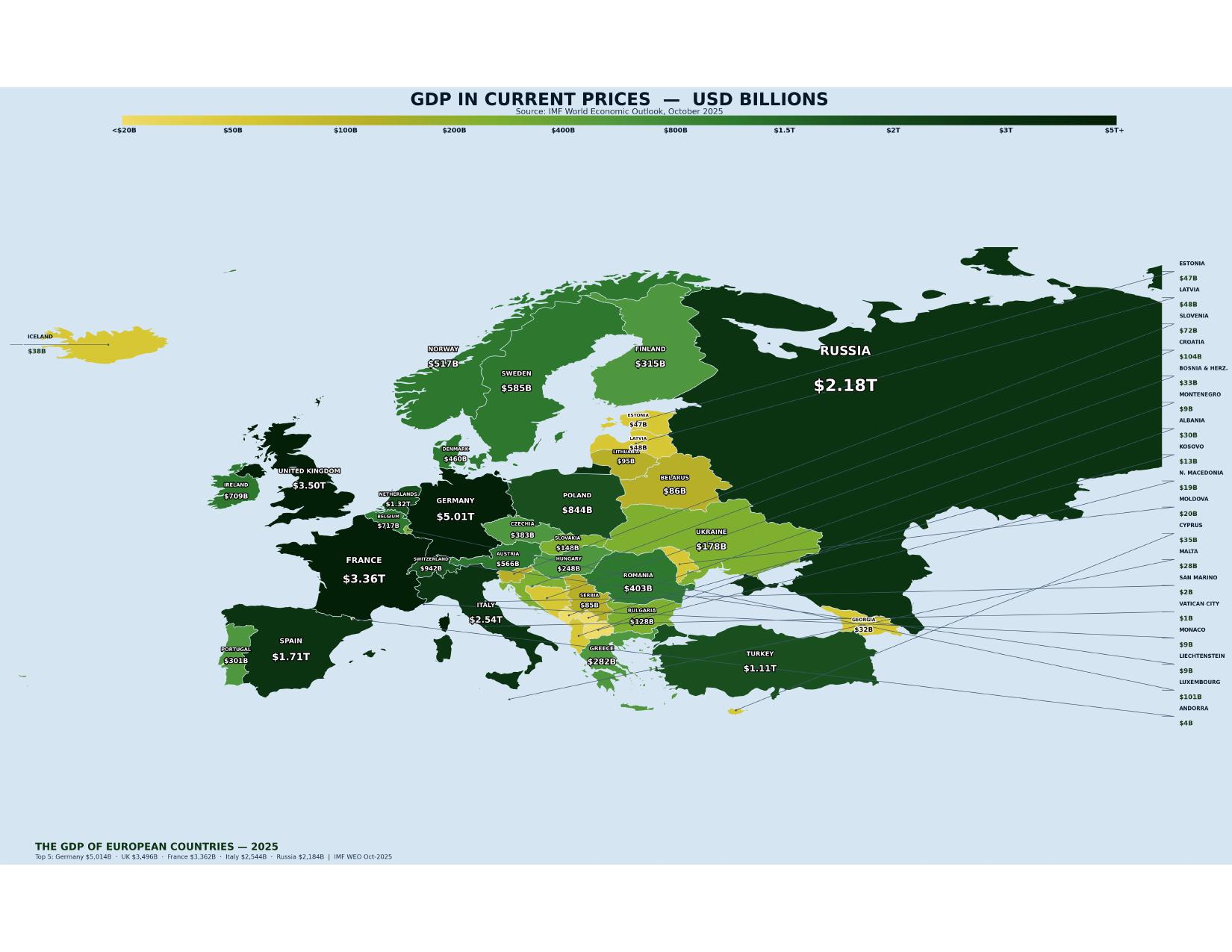
Europe GDP 2025: Understanding the Regional Economic Landscape
Nominal GDP across European economies, the region's concentration of scale, and why macroeconomic size must be paired with industry-specific intelligence.
August 14, 2026 · 5 min read

South Africa Data Center Market & Infrastructure Intelligence
Global market sizing to 2035, the six data center operating models, the industrial inputs behind power and cooling systems, and South Africa's engineering and construction ecosystem.
August 18, 2026 · 9 min read

Spain & Italy Wine Market Intelligence: Industry Structure, Global Reach and African Opportunities
How Spain and Italy's wine economies differ, which companies lead on revenue, exports, production and prestige, and where their distribution reaches in Africa and Australia.
August 28, 2026 · 10 min read